New-Energy / Lithium-Battery Production Line · G220 + G160 Whole-Line Joint Tuning & OCR Verification
For lithium-battery, photovoltaic, and new-energy-vehicle production lines, APM-G220 takes over the PC master-control stations while AIS-G160 collects data from PLC-controlled equipment — forming a dual closed loop of visual + protocol verification that cuts model-change tuning from 1–3 days down to 2–4 hours.
Core Solution for This Scenario
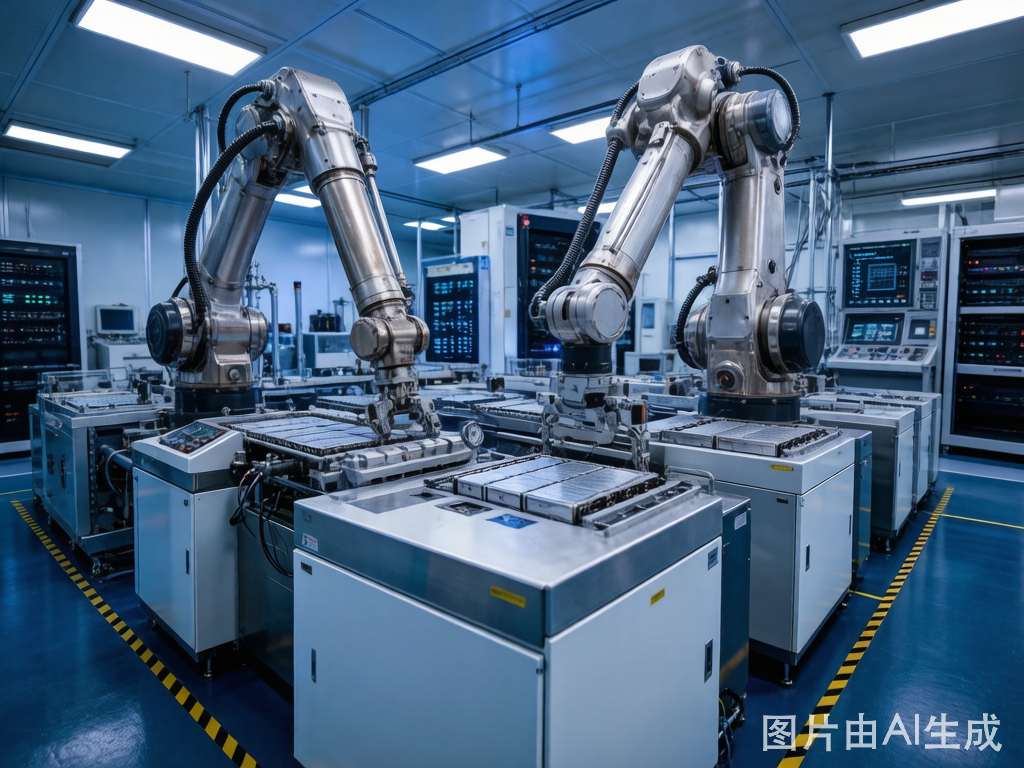
New-energy production lines are a hybrid of "PC master control + PLC control" — inspection stations and MES clients run on the PC, while core equipment such as coaters, winders, and formation cabinets is controlled by PLCs. Changing product models requires modifying both PC-side parameters and PLC-side registers, spanning two separate systems and two sets of protocols, where manual operation is highly prone to omissions or misconfiguration. The "visual closed loop + protocol closed loop" dual check is purpose-built for exactly this hybrid control architecture.
I. Industry Pain Points
Typical challenges in equipment operation, maintenance, and data acquisition across new-energy / lithium-battery / photovoltaic production lines.
- Behind every process there are two control paradigms: PC/industrial-PC-driven inspection stations plus PLC + HMI–controlled dedicated equipment. Changing product models manually retunes 50–100 machines across the line, typically taking 1–3 days.
- PLC + HMI equipment has no standard video output, so conventional screen-viewing operation methods cannot access it.
- PC master-control stations rely on one-by-one manual operation with no automated verification, resulting in a 3–8% parameter error rate.
- Equipment comes from many different brands with disparate control systems, making unified automation difficult.
II. Solutions
Build a dual-source data closed loop of "screen layer + protocol layer" using the AIXOT non-invasive gateway combination.
- APM-G220 handles PC master-control equipment (inspection stations, formation/capacity-grading hosts, vision inspection, MES terminals): HDMI capture + USB keyboard/mouse emulation to deliver automated parameter entry and OCR visual verification.
- AIS-G160 handles PLC/dedicated-controller equipment (coaters, roller presses, slitters, winders, filling machines, formation cabinets): register reads via RS485/Ethernet ports, program-number dispatch, and reverse control.
- Visual closed loop: G220 sets parameters → screenshots → OCR comparison → confirmation → release. Protocol closed loop: G160 dispatches program number → reads register → readback confirmation. Neither of the two verification loops can be omitted.
- MES simultaneously issues model-change commands to G220/G160 in batches per work order, and archives the tuning records and messages to the quality system.
III. Deployment Steps
An executable path from interface inventory to standardized closed-loop operation.
- Inventory the control mode of each production-line device (PC master vs. PLC control) and define the G220/G160 access scope
- G220 takes over the PC master-control stations, records the tuning scripts, and inserts OCR verification nodes
- G160 connects to the PLC equipment, configures protocol templates and the acquisition cycle, and enables program-number dispatch
- MES issues unified model-change commands, and G220/G160 run the dual closed-loop check in parallel.
- Parameter-tuning records, screenshots, OCR results, and protocol messages are archived in the MES quality-management system
IV. System Integration & Data Interconnection
Standardized integration points with MES / SCADA / PLC / quality systems.
- MES integration: work orders drive batch model changes on G220/G160, with result writeback
- Quality-system integration: OCR results + protocol messages feed batch-level traceability
- Complementing the G160 protocol closed loop: PLC device readback confirmation
- T100 OCR fallback: screen-point acquisition where no protocol is available
V. Value & Quantitative Indicators
Measurable benefits delivered by the non-invasive solution.
VI. Deployment Boundaries & Compliance Red Lines
Compliance & Applicable Boundaries
New-energy production lines are generally non-sensitive industries and may be commissioned over the 4G public network for non-sensitive debugging; however, for customers involving core process parameters, a private network/intranet is recommended. The G220 applies only to PC master-control stations, while PLC-controlled equipment is handled by the AIS-G160.
VII. Frequently Asked Questions (FAQ)
Frequently asked questions for new-energy / lithium-battery / photovoltaic production-line scenarios.
How to connect PLC + HMI equipment?
AIS-G160 reads registers and dispatches program numbers via the RS485/Ethernet port, while G220 is responsible only for PC master-control stations.
How can parameter errors be avoided?
The G220 visual closed loop (OCR comparison) + G160 protocol closed loop (readback confirmation) provide a dual check, driving the error rate to near zero.
How long is production stopped for a model change?
With G220 + G160 combined automatic parameter tuning, a model change takes 2–4 hours — far shorter than the 1–3 days required manually.
Can equipment from different brands be unified?
Yes. The G160's 500+ protocol libraries cover mainstream PLCs, while G220 masks station-interface differences, managing the entire line as one.
In the 'New-Energy / Lithium-Battery / Photovoltaic Production Line' scenario, which CNC, PLC, and injection-molding brands can G160 connect to?
AIS-G160 ships a 500+ industrial-protocol driver library, verified for CNC systems from FANUC, Siemens, Mitsubishi, SYNTEC; PLCs from Siemens, Mitsubishi, OMRON, Delta, Inovance; and injection-molding machines from Techmation, Keqiang, Mediatek, Chen Hsong. See the 'Device Compatibility' list on this page for specific models; some legacy devices require on-site confirmation of network/extension-module conditions.
Related Scenarios and Products
Robot/Automation
Multi-brand communication-protocol acquisition and linkage monitoring
→ View ScenarioCNC Machine Tools Brands & Models Supported by G160
AIS-G160 ships a 500+ industrial-protocol driver library with native brand support for dedicated controllers (CNC, injection molding, robots) that generic gateways struggle to connect. Below are mainstream brands and models verified for data acquisition (some models require on-site confirmation of interface conditions).
| Brand | Supported Models / Comms |
|---|---|
| FANUC | All systems with an Ethernet port can communicate; for systems without an Ethernet port, on-site confirmation is required to determine whether an expansion module can be added |
| SYNTEC | System version 10.116.16X or later |
| Mitsubishi | E70, M70, M700, E80, M80, M800 |
| BROTHER | Systems with an Ethernet port |
| SIEMENS | 828D, 828DSL, 840DSL, 808D/808DSL (Ethernet-capable) |
| Haas | Full Ethernet series / full serial-port series |
| KND | Systems with an Ethernet port |
| GSK | All Ethernet-capable systems; 988 series, 25imc, etc. |
| Other Ethernet-capable brands | HNC, Mazak, HEIDENHAIN, Huazhong CNC, etc. can also be connected via the edge gateway |
PLC (Programmable Logic Controller) Brands & Models Supported by G160
AIS-G160 ships a 500+ industrial-protocol driver library with native brand support for dedicated controllers (CNC, injection molding, robots) that generic gateways struggle to connect. Below are mainstream brands and models verified for data acquisition (some models require on-site confirmation of interface conditions).
| Manufacturer / Brand | Typical Series & Models | Comms | Protocol / Driver |
|---|---|---|---|
| Siemens | S7-200 (PPI), S7-300/400 (MPI), S7-200 Smart, S7-1200, S7-1500, LOGO! | Serial / Ethernet | S7 PPI, MPI, S7comm, Modbus TCP |
| Mitsubishi | FX0/FX1/FX2, FX3U/3G, Q series (Q00J/Q00/Q02/Q02H/Q06H/Q12H/Q25H, QnU Q00U~Q26U, QnA/A series), FX3U-ENET, FX5U, QJ71E71 | Serial / Ethernet | Mitsubishi MC, MELSEC, SLMP |
| Rockwell AB | Micro800 | Ethernet | EtherNet/IP |
| LS | XGT, XGB, XBC-DN32U | Serial / Ethernet | Proprietary protocol |
| Modbus | Standard Modbus devices | Serial / Ethernet | Modbus RTU / ASCII / TCP / RTU over TCP |
| Schneider | Full range | Serial / Ethernet | Modbus RTU / TCP |
| Power utility protocols | Power utility terminals | Serial / Ethernet | IEC 60870-5-101, DNP3.0, IEC 60870-5-104 |
| HollySys | LE/LK220, LK210 | Serial / Ethernet | Modbus RTU |
| THINGET | XD/XL, XC | Serial / Ethernet | Modbus TCP |
| Inovance | H1U/H2U, H3U, H5U | Serial / Ethernet | Modbus |
| OMRON | CJ/CS, CV, CP | Serial / Ethernet | OMRON FINS, Ethernet TCP |
| FATEK | Full range | Serial / Ethernet | Proprietary protocol |
| Delta | DVP, AS228T | Serial / Ethernet | Modbus RTU / TCP |
| Panasonic | FPX, FP | Serial / Ethernet | MEWTOCOL_COM |
| Haiwell | Full range | Serial | Modbus RTU / ASCII |
| Kewei | LP series | Serial | Modbus RTU / proprietary protocol |
| Meters / Environmental / Building Automation | Smart meters, environmental monitoring, building-automation devices | Serial / Ethernet | CJ/T188, DL/T645 (2007/1997), HJ212, BACnet MS/TP, BACnet IP |
| OPC UA | Software/devices that support OPC UA | Ethernet | OPC UA |