Robot / Automation · Multi-Brand Protocol Acquisition & Line Interlocking Monitoring
For multi-brand industrial-robot production lines, a protocol gateway uniformly collects robot status, cycle time, alarms and I/O, enabling line-wide interlocking monitoring and cycle-time optimisation while shrinking anomaly-detection time.
Core solution for this scenario
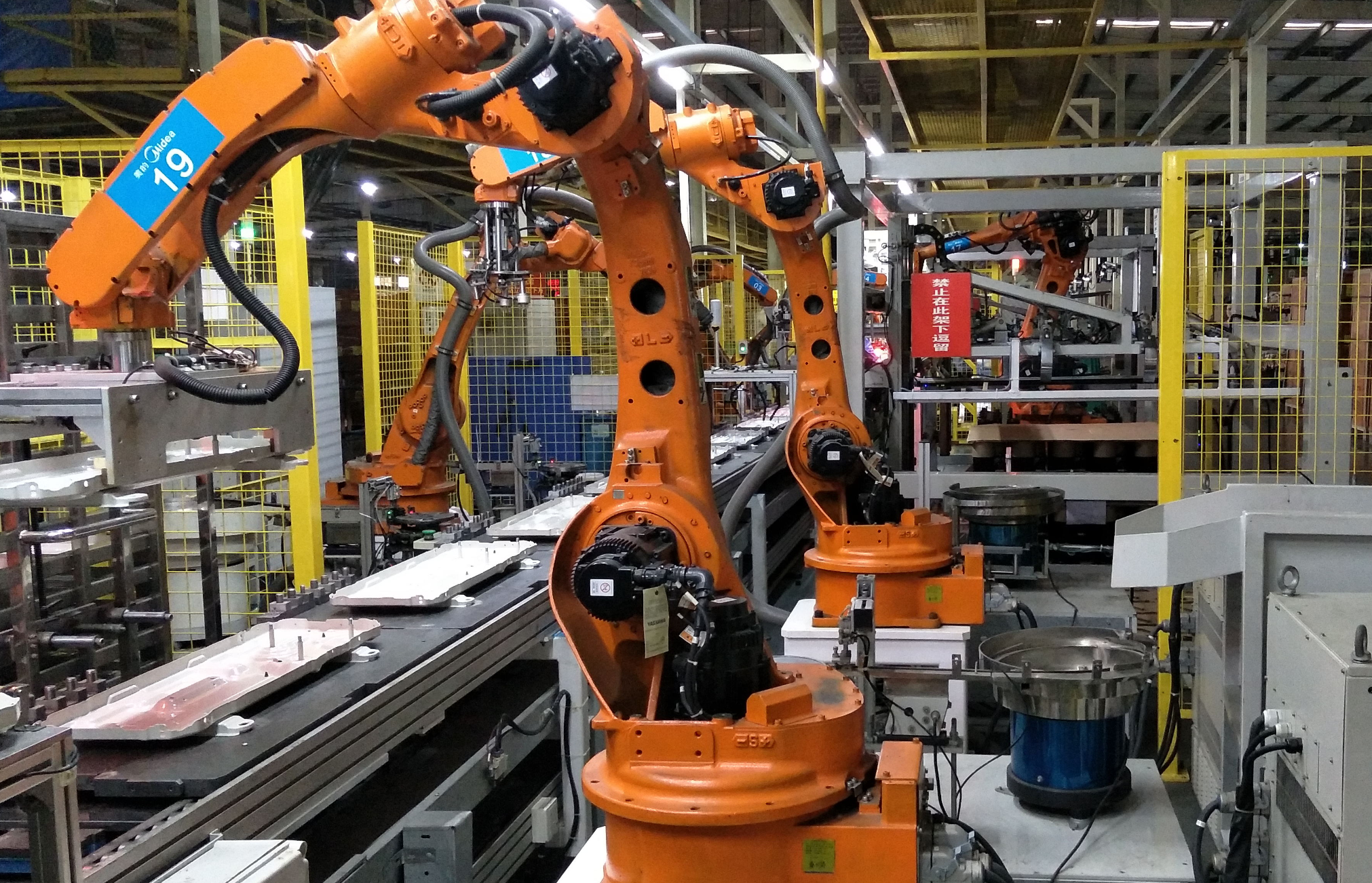
I. Industry Pain Points
Typical challenges for Industrial Robot / Automation Line in equipment O&M and data acquisition.
- Line robots are heterogeneous (Fanuc, KUKA, Yaskawa, ABB, etc.) with differing communication protocols; status and alarms are scattered and there is no unified monitoring view.
- Hidden losses such as abnormal cycle times, idle travel and waiting are hard to detect in time, hurting the takt and output of the whole line.
- Robots are hard to locate interlocking faults with PLCs, vision and conveyors; alarms sit inside separate controllers and troubleshooting relies on experience running around the line.
- The lack of standardised data makes cycle-time analysis and bottleneck identification difficult.
At an automotive-parts factory in East China, the welding workshop runs 12 robots from two brands — Fanuc and KUKA — and cycle-time anomalies were only caught by manual line patrols, averaging a 15–20 minute lag. After deploying the G160, status and cycle-time data from all 12 robots is aggregated into the DVS Data-Acquisition & Visualization Platform in real time; cycle-time anomalies trigger automatic alarm alerts in under 5 minutes, interlocking-fault locating time dropped by 30%, and robot OEE went from invisible to a real-time dashboard.
II. Solution
Build a "screen layer + protocol layer" dual-source data closed loop with the AIXOT non-intrusive gateway combination.
- AIS-G160 Industrial Protocol Gateway uses its 500+ protocol library to unify access to each robot brand, collecting running status, cycle time, alarm codes, I/O and joint load, and models them at the edge.
- Robot status is associated with PLC, conveyor and vision signals on a timeline to support line-wide interlocking monitoring, automatically locating a cycle-time anomaly to a specific station and device.
- The G160 supports reverse control (start / stop, homing, mode switching) within authorised limits, coordinating with MES / SCADA for line orchestration.
- Cycle-time and alarm data are precipitated into a dashboard to identify bottleneck stations and idle losses, driving cycle-time optimisation.
III. Deployment Steps
An executable path from interface inventory to a standardised closed loop.
- Inventory robot brands / controller models and communication interfaces (Ethernet / PROFINET / EtherNet/IP)
- Configure the G160 robot protocol template to collect status / cycle time / alarms / I/O and compute metrics at the edge
- Establish interlocking monitoring by correlating robot with PLC / vision / conveyor signals along the station timeline
- Set cycle-time thresholds and alarm-interlock rules to auto-locate an anomaly to the station and alarm
- Connect the cycle-time dashboard to MES to identify bottleneck stations and drive cycle-time and scheduling optimisation
IV. System Integration & Data Connectivity
Standardised connection points with MES / SCADA / PLC / quality systems.
- Connect to PLC / SCADA: robot I/O and status interlocked via PROFINET / EtherNet/IP
- Connect to MES: cycle time and output reported up, supporting production and OEE
- Connect to the vision system: inspection results correlated with robot actions to improve yield
- Complement with G220: robots with an industrial-PC screen are taken over by the G220
V. Value & Quantified Metrics
Measurable benefits from the non-intrusive solution.
VI. Deployment Boundaries & Compliance Red Lines
Compliance & applicable boundaries
A general industrial-robot line in a non-sensitive industry may be commissioned over the 4G public network for non-sensitive work; confidential lines must use a private network / intranet. The G220 applies only to industrial robots with video output and USB input. Pure controller protocol acquisition is handled by AIS-G160 Industrial Protocol Gateway.
VII. FAQ
High-frequency questions for the Industrial Robot / Automation Line scenario.
Can different robot brands be monitored together?
Yes. The G160 protocol library covers mainstream robots such as Fanuc, KUKA, Yaskawa and ABB; heterogeneous protocols are modelled into a single unified data model.
How is an abnormal cycle time detected quickly?
The G160 continuously collects cycle times and correlates upstream / downstream signals on a timeline, automatically locating the offending station and device — cutting detection from experienced walk-around troubleshooting to the minute level.
Can it interlock with the PLC?
Yes. Robot I/O and status are interlocked with the PLC via PROFINET / EtherNet/IP to support line coordination and reverse control.
What if an old line robot exposes no open protocol?
Its industrial-PC screen can be OCR-captured through APM-G220 Non-intrusive Smart Tuning Gateway as a non-intrusive fallback; Ethernet / serial ports are handled by the G160 protocol library.
In the 'Industrial Robot / Automation Line' scenario, which CNC, PLC and injection-molding brands can G160 connect to?
AIS-G160 ships a 500+ industrial-protocol driver library, verified for CNC systems from FANUC, Siemens, Mitsubishi, SYNTEC; PLCs from Siemens, Mitsubishi, OMRON, Delta, Inovance; and injection machines from Techmation, Keqiang, Mediatek, Chen Hsong. See the 'Device Compatibility' list on this page for specific models; some legacy devices require on-site confirmation of network/extension-module conditions.
Related Scenarios & Products
Electronics Assembly / SMT
Multi-brand device data acquisition and correlation analysis
→ View ScenarioRobot / Automation
Multi-brand communication-protocol acquisition and interlocking monitoring
→ View ScenarioCNC Machine Tools Brands & Models Supported by G160
AIS-G160 ships a 500+ industrial-protocol driver library with native brand support for dedicated controllers (CNC, injection molding, robots) that generic gateways struggle to connect. Below are mainstream brands and models verified for data acquisition (some models require on-site confirmation of interface conditions).
| Brand | Supported Models / Comms |
|---|---|
| FANUC | All systems with an Ethernet port can communicate; for systems without an Ethernet port, on-site confirmation is required to determine whether an expansion module can be added |
| SYNTEC | System version 10.116.16X or later |
| Mitsubishi | E70, M70, M700, E80, M80, M800 |
| BROTHER | Systems with an Ethernet port |
| SIEMENS | 828D, 828DSL, 840DSL, 808D/808DSL (Ethernet-capable) |
| Haas | Full Ethernet series / full serial-port series |
| KND | Systems with an Ethernet port |
| GSK | All Ethernet-capable systems; 988 series, 25imc, etc. |
| Other Ethernet-capable brands | HNC, Mazak, HEIDENHAIN, Huazhong CNC, etc. can also be connected via the edge gateway |
PLC (Programmable Logic Controller) Brands & Models Supported by G160
AIS-G160 ships a 500+ industrial-protocol driver library with native brand support for dedicated controllers (CNC, injection molding, robots) that generic gateways struggle to connect. Below are mainstream brands and models verified for data acquisition (some models require on-site confirmation of interface conditions).
| Manufacturer / Brand | Typical Series & Models | Comms | Protocol / Driver |
|---|---|---|---|
| Siemens | S7-200 (PPI), S7-300/400 (MPI), S7-200 Smart, S7-1200, S7-1500, LOGO! | Serial / Ethernet | S7 PPI, MPI, S7comm, Modbus TCP |
| Mitsubishi | FX0/FX1/FX2, FX3U/3G, Q series (Q00J/Q00/Q02/Q02H/Q06H/Q12H/Q25H, QnU Q00U~Q26U, QnA/A series), FX3U-ENET, FX5U, QJ71E71 | Serial / Ethernet | Mitsubishi MC, MELSEC, SLMP |
| Rockwell AB | Micro800 | Ethernet | EtherNet/IP |
| LS | XGT, XGB, XBC-DN32U | Serial / Ethernet | Proprietary protocol |
| Modbus | Standard Modbus devices | Serial / Ethernet | Modbus RTU / ASCII / TCP / RTU over TCP |
| Schneider | Full range | Serial / Ethernet | Modbus RTU / TCP |
| Power utility protocols | Power utility terminals | Serial / Ethernet | IEC 60870-5-101, DNP3.0, IEC 60870-5-104 |
| HollySys | LE/LK220, LK210 | Serial / Ethernet | Modbus RTU |
| THINGET | XD/XL, XC | Serial / Ethernet | Modbus TCP |
| Inovance | H1U/H2U, H3U, H5U | Serial / Ethernet | Modbus |
| OMRON | CJ/CS, CV, CP | Serial / Ethernet | OMRON FINS, Ethernet TCP |
| FATEK | Full range | Serial / Ethernet | Proprietary protocol |
| Delta | DVP, AS228T | Serial / Ethernet | Modbus RTU / TCP |
| Panasonic | FPX, FP | Serial / Ethernet | MEWTOCOL_COM |
| Haiwell | Full range | Serial | Modbus RTU / ASCII |
| Kewei | LP series | Serial | Modbus RTU / proprietary protocol |
| Meters / Environmental / Building Automation | Smart meters, environmental monitoring, building-automation devices | Serial / Ethernet | CJ/T188, DL/T645 (2007/1997), HJ212, BACnet MS/TP, BACnet IP |
| OPC UA | Software/devices supporting OPC UA | Ethernet | OPC UA |