Machining / CNC · Multi-Brand Machine Data Acquisition & OEE Improvement
For multi-brand CNC machine shops, an industrial protocol gateway unifies the collection of equipment status, output, alarms and tool-life data, while the G220 provides screen-level fallback capture for legacy machines — raising OEE and sharpening tool management.
Core solution for this scenario
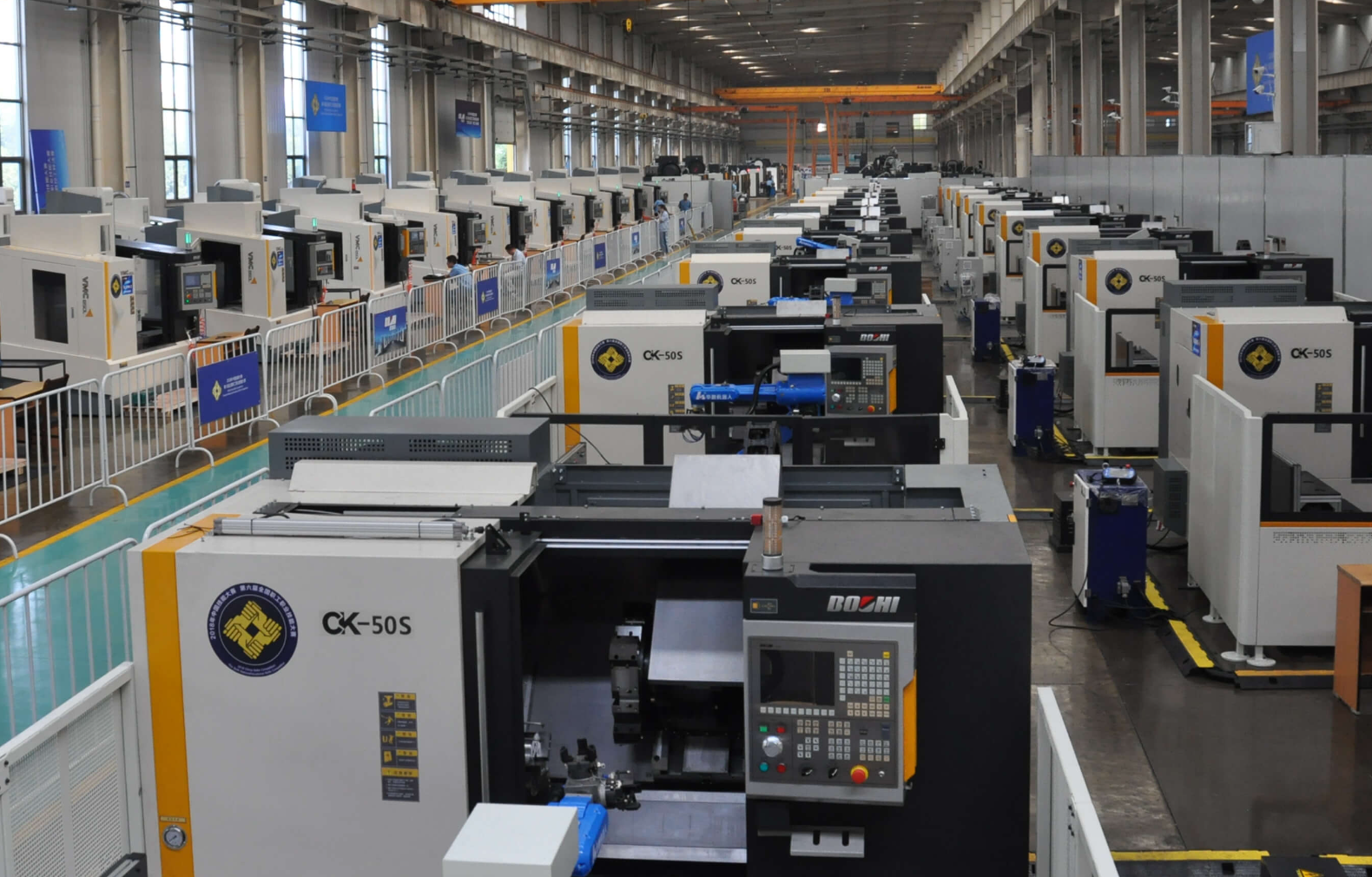
The accuracy of OEE in a machining shop depends on the completeness of data acquisition — collecting only "running / stopped" status yields a seriously inflated availability rate; spindle load, feed override, program number and tool life must all be collected together to derive the true performance availability and quality availability. Furthermore, the protocol heterogeneity across multi-brand CNC (Fanuc / Mitsubishi / Siemens / Heidenhain) is the biggest technical barrier to machining data acquisition.
I. Industry Pain Points
Typical challenges for Machining / CNC Machine Tools in equipment O&M and data acquisition.
- Shop-floor CNC brands are highly mixed (Fanuc, Siemens, Mitsubishi, Heidenhain, etc.) with disparate protocols; equipment status, output and alarms still rely on manual logging, so OEE cannot be measured accurately.
- Tool-life management lacks data support and tends to depend on experience — changing tools too early wastes life, too late risks scrap and tool crashes.
- Legacy CNCs have no network card and expose no open protocol, becoming blind spots in data collection that can never be brought into the digital shop floor.
- Downtime causes are scattered and hard to attribute, so the cost of unplanned downtime stays hidden and high.
II. Solution
Build a "screen layer + protocol layer" dual-source data closed loop with the AIXOT non-intrusive gateway combination.
- AIS-G160 Industrial Protocol Gateway connects to mainstream CNC controls through a 500+ protocol library (covering 90%+ of mainstream brands including Fanuc, Siemens, Mitsubishi and Heidenhain), collecting run / idle / alarm status, part counts, feed override, alarm codes and tool-life counts, and sends data to the DVS/MES platform for OEE modeling.
- The G160 supports program upload/download (API-encapsulated; upper-layer applications can directly deploy machining programs with read-back verification) and M-code register read/write (register read/write to CNC internal PLC, enabling interaction between upper-layer applications / external devices such as loading/unloading robots and CNC machines), forming a collect–upload–control data closed loop.
- Port-less legacy CNCs are taken over non-intrusively by APM-G220 Non-intrusive Smart Tuning Gateway; OCR captures operating status and counts to eliminate data blind spots.
- Equipment status, tool life and alarms are aggregated per machine, supporting an OEE dashboard and predictive tool changes.
III. Deployment Steps
An executable path from interface inventory to a standardised closed loop.
- Inventory CNC brands / control models and communication interfaces (Ethernet / RS232 / OPC UA)
- Configure the G160 CNC protocol template to collect status / output / alarms / tool counts and send data to DVS/MES platform for OEE modeling
- For legacy CNCs without an Ethernet port, the G220 takes over the screen and records an OCR capture script as fallback
- Build a tool-life model that auto-prompts tool changes near threshold and attributes abnormal alarms
- Feed the OEE and downtime-cause dashboard into MES to drive capacity and scheduling optimisation
IV. System Integration & Data Connectivity
Standardised connection points with MES / SCADA / PLC / quality systems.
- Connect to MES / shop-floor dashboards: status and output reported via OPC UA / Modbus
- Connect to the tool-management system: tool-life counts drive predictive tool changes
- Complement the G220 screen fallback: OCR capture for legacy devices without a protocol
- Connect to the predictive-maintenance platform: joint prediction from alarms and vibration data
V. Value & Quantified Metrics
Measurable benefits from the non-intrusive solution.
VI. Deployment Boundaries & Compliance Red Lines
Compliance & applicable boundaries
General, non-sensitive machining industries may use the 4G public network for non-sensitive commissioning; however, military and other confidential machining must run on a private network / intranet. The G220 applies only to CNC operator panels / industrial PCs with video output and USB input. Pure controller protocol acquisition is handled by AIS-G160 Industrial Protocol Gateway.
VII. FAQ
High-frequency questions for the Machining / CNC Machine Tools scenario.
Can CNCs from different controls be collected uniformly?
Yes. The G160 protocol library covers mainstream CNCs such as Fanuc, Siemens, Mitsubishi and Heidenhain; less common controls can be connected via a custom protocol / register mapping.
How is tool life managed?
The G160 collects tool-life counts and alarms, and prompts a tool change as the threshold approaches — reducing both premature waste and late-stage scrap.
Can a legacy CNC without a network port be collected?
Yes. APM-G220 Non-intrusive Smart Tuning Gateway takes over the screen non-intrusively and OCR-captures operating status and counts, serving as a fallback for protocol-based collection.
Can machining programs be deployed and M-code interaction performed?
Yes. The G160 supports API-encapsulated program upload/download — upper-layer applications can directly deploy machining programs to the CNC with read-back verification — as well as M-code register read/write (register read/write to the CNC internal PLC, enabling interaction between upper-layer applications and external devices such as loading/unloading robots with the CNC machine), forming a data closed loop with the MES/DVS platform.
In the 'Machining / CNC Machine Tools' scenario, which CNC, PLC and injection-molding brands can G160 connect to?
AIS-G160 ships a 500+ industrial-protocol driver library, verified for CNC systems from FANUC, Siemens, Mitsubishi, SYNTEC; PLCs from Siemens, Mitsubishi, OMRON, Delta, Inovance; and injection machines from Techmation, Keqiang, Mediatek, Chen Hsong. See the 'Device Compatibility' list on this page for specific models; some legacy devices require on-site confirmation of network/extension-module conditions.
Related Scenarios & Products
Robot / Automation
Multi-brand communication-protocol acquisition and interlocking monitoring
→ View ScenarioElectronics Assembly / SMT
Multi-brand device data acquisition and correlation analysis
→ View ScenarioCNC Machine Tools Brands & Models Supported by G160
AIS-G160 ships a 500+ industrial-protocol driver library with native brand support for dedicated controllers (CNC, injection molding, robots) that generic gateways struggle to connect. Below are mainstream brands and models verified for data acquisition (some models require on-site confirmation of interface conditions).
| Brand | Supported Models / Comms |
|---|---|
| FANUC | All systems with an Ethernet port can communicate; for those without one, on-site confirmation is required on whether an expansion module can be added |
| SYNTEC | System version 10.116.16X and above |
| Mitsubishi | E70, M70, M700, E80, M80, M800 |
| Brother | Systems with an Ethernet port |
| Siemens | 828D, 828DSL, 840DSL, 808D/808DSL (Ethernet-capable) |
| Haas | Full range, Ethernet / Full range, serial |
| KND | Systems with an Ethernet port |
| GSK | All with Ethernet port; 988 series, 25imc, etc. |
| Other Ethernet-capable brands | HNC, Mazak, HEIDENHAIN, HNC, etc. can also be connected via the edge gateway |
PLC (Programmable Logic Controller) Brands & Models Supported by G160
AIS-G160 ships a 500+ industrial-protocol driver library with native brand support for dedicated controllers (CNC, injection molding, robots) that generic gateways struggle to connect. Below are mainstream brands and models verified for data acquisition (some models require on-site confirmation of interface conditions).
| Manufacturer / Brand | Typical Series & Models | Comms | Protocol / Driver |
|---|---|---|---|
| Siemens | S7-200 (PPI), S7-300/400 (MPI), S7-200 Smart, S7-1200, S7-1500, LOGO! | Serial / Ethernet | S7 PPI, MPI, S7comm, Modbus TCP |
| Mitsubishi | FX0/FX1/FX2, FX3U/3G, Q series (Q00J/Q00/Q02/Q02H/Q06H/Q12H/Q25H, QnU Q00U~Q26U, QnA/A series), FX3U-ENET, FX5U, QJ71E71 | Serial / Ethernet | Mitsubishi MC, MELSEC, SLMP |
| Rockwell AB | Micro800 | Ethernet | EtherNet/IP |
| LS | XGT, XGB, XBC-DN32U | Serial / Ethernet | Proprietary protocol |
| Modbus | Standard Modbus devices | Serial / Ethernet | Modbus RTU / ASCII / TCP / RTU over TCP |
| Schneider | Full range | Serial / Ethernet | Modbus RTU / TCP |
| Power utility protocols | Power utility terminals | Serial / Ethernet | IEC 60870-5-101, DNP3.0, IEC 60870-5-104 |
| HollySys | LE/LK220, LK210 | Serial / Ethernet | Modbus RTU |
| THINGET | XD/XL, XC | Serial / Ethernet | Modbus TCP |
| Inovance | H1U/H2U, H3U, H5U | Serial / Ethernet | Modbus |
| OMRON | CJ/CS, CV, CP | Serial / Ethernet | OMRON FINS, Ethernet TCP |
| FATEK | Full range | Serial / Ethernet | Proprietary protocol |
| Delta | DVP, AS228T | Serial / Ethernet | Modbus RTU / TCP |
| Panasonic | FPX, FP | Serial / Ethernet | MEWTOCOL_COM |
| Haiwell | Full range | Serial | Modbus RTU / ASCII |
| Kewei | LP series | Serial | Modbus RTU / proprietary protocol |
| Meters / Environmental / Building Automation | Smart meters, environmental monitoring and building-control devices | Serial / Ethernet | CJ/T188, DL/T645 (2007/1997), HJ212, BACnet MS/TP, BACnet IP |
| OPC UA | Software / devices supporting OPC UA | Ethernet | OPC UA |