CNC Loading Robot
Protocol Linkage Replaces Wireless I/O
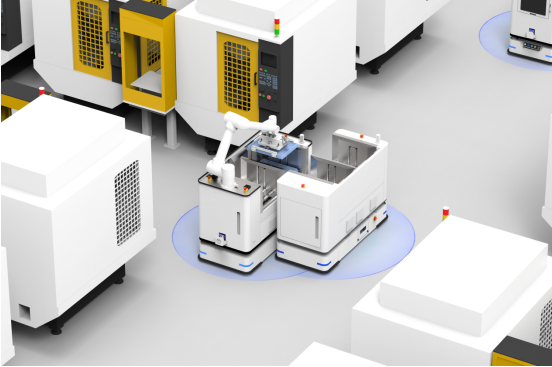
In a machining workshop, one loading/unloading robot (AGV chassis + robotic arm) manages about 10 CNC machines, but the robot-CNC "handshake" long relied on retrofit wireless I/O modules. AIS-G160 replaces wireless I/O with protocol-level linkage, performing D/M register read/write and M-code triggering, and supporting CNC program up/download with read-back verification — turning "loading/unloading automation" into a "full-process automated closed loop".
Core solution for this case
I. Customer Background
The machining workshop organizes production as unmanned loading/unloading cells of "robot + multiple CNC machines".
- The customer is a machining enterprise that organizes production in its machining workshop as "loading/unloading robot + multiple CNC machines", pursuing fewer operators and continuous production cadence.
- A single loading/unloading robot (AGV chassis + robotic arm) can manage about 10 CNC machines, replacing manual loading/unloading and other repetitive tasks — a critical part of workshop automation.
II. Core Pain Points
The "handshake" between robot and CNC has long been the weak link of automated production lines.
- Communication relies on wireless I/O modules — complex wiring, prone to failure: The traditional approach adds a wireless I/O module behind each CNC, triggering actions (door open/close, blow, machining) via different I/O points. Modules require on-site wiring, pairing and address setup; deployment is cumbersome, and wireless signals are vulnerable to workshop EMI with occasional dropouts. Failure points are scattered across 10 CNC × N I/O points.
- Can only trigger simple functions, cannot sense internal CNC status: Wireless I/O only gets limited on/off signals like "door open / door closed". It cannot read the CNC current mode, progress, alarm codes or active program number — the robot can only "operate blind", waiting on fixed delays, with conservative cadence and low efficiency.
- Cannot perform complex logic control: Limited by I/O point count, only simple on/off actions are possible. Any process-conditional branching, macro calls or stage-based linkage forces a fallback to manual operation.
- Program changes rely on manual copying — breaks at the "last mile": CNC programs are still copied in via USB/CF card manually. Program changes mean downtime. Although loading/unloading is automated, program management, first-piece confirmation and exception handling still depend on people — the line is never truly "fully automated".
- Maintenance black box: The 10 wireless I/O modules operate independently with no unified monitoring or remote diagnosis; when something fails, staff must go to each machine to troubleshoot one by one.
III. Why Traditional Approaches Fail
Wireless I/O, constrained by its inherent architecture, cannot support protocol-level linkage that "sees status and controls actions".
- Wireless I/O is essentially "remote on/off triggering" with no data-plane connection to the CNC — it cannot read or write internal CNC registers, locking control dimensions at "on/off".
- The workshop complex EMI environment causes occasional wireless link dropouts that fail the "handshake", causing cadence chaos or even collision risk — stability cannot match continuous production requirements.
- Program changes still require manual USB copying; automation ends abruptly at the "last mile". The 10 wireless modules have no unified management, making fault location and remote O&M impossible.
IV. Solution: AIS-G160 Protocol Linkage
Connect directly via native CNC protocol instead of wireless I/O; use register read/write and program up/download to close the automation loop.
- Protocol connection replaces wireless I/O modules: G160 connects directly to the CNC controller via RS232 / Ethernet, establishing a protocol-level channel (FOCAS / SINUMERIK / M70, etc.), fully replacing retrofit wireless I/O. One G160 per CNC — plug-and-play, standardized configuration. 10 CNC = 10 G160, unified management, remotely maintainable; failure points shrink from "N wireless I/O points" to "1 gateway / CNC".
- Read D/M registers → fully sense CNC status: The upper scheduling system reads CNC mode, current process, progress, alarm codes, active program number in real time. The robot no longer "waits blindly" but "acts on status" — whether the door is open, whether it is machining, whether there is an alarm is clear at a glance.
- Write registers / M-codes → precisely control CNC actions: Door open/close, blow, start machining are no longer dependent on fixed I/O triggers, but implemented via M-code writes combined with macros, expressing complex branching and process logic — control dimension upgraded from "on/off" to "protocol-level".
- Program up/down load completes the "last mile": The upper system pushes CNC programs via API; after pushing, it reads back for verification to confirm complete write before starting. Program changes require no downtime, no USB. CNC-side actions are driven by G160 register reads/writes; robot-side actions by the scheduling system; the two align via the G160 protocol channel.
- Full-process automated closed loop: Program push → notify robot to approach target CNC → G160 reads status for safe confirmation, writes M-code to open door → robot loads and exits → write M-code to close door and start machining → machining done, door opens, notify robot to unload → unload then load, next cycle fully unmanned.
V. Value Comparison & Results
Upgrade from "semi-auto loading/unloading" to a full-process automated closed loop of "program push — load/unload — machining — unload".
| Comparison | Wireless I/O Module Approach | AIS-G160 Protocol Linkage |
|---|---|---|
| Communication | Retrofit wireless I/O, complex wiring | Protocol-direct to CNC controller, plug-and-play standardized |
| Stability | Prone to interference, occasional dropouts, scattered failures | Stable, reliable protocol communication, resistant to workshop EMI |
| Status sensing | Only limited on/off like "door open/closed" | Reads D/M registers: mode / progress / alarm / program number |
| Control capability | Simple I/O trigger (on/off) | M-code + macro, complex process logic orchestration |
| Program management | Manual USB/CF copy, downtime on change | API program up/down + read-back verification, no downtime on change |
| Automation level | Semi-auto (auto load/unload, manual change/debug) | Full-process auto: program push → load/unload → machining → unload loop |
| Maintenance cost | N wireless modules, independent, no remote | 1 G160 / CNC, unified mgmt, remote maintainable |
VI. Why AIS-G160
The three capabilities "complete protocols + register read/write + program up/download" exactly match all requirements of loading/unloading linkage.
- Complete protocols: AIS-G160 supports 500+ industrial protocols, including native drivers for mainstream CNC brands (FANUC FOCAS, Siemens SINUMERIK, Mitsubishi M70/M80, HEIDENHAIN, GSK, etc.); mainstream CNC controllers are 90%+ supported — no per-brand development.
- M-code register read/write: Supports D/M register read/write to the CNC internal PLC, enabling "register-level" interaction between upper applications / external devices (loading robot) and the CNC — the robot knows what the CNC needs, the CNC knows what the robot did: a bidirectional closed loop.
- Program up/down load: API-encapsulated; upper applications can push CNC programs directly and read back for verification, forming an "acquire — upload — feedback control" data loop with MES / DVS platforms.
- Compliant, flexible deployment: General machining workshops use the workshop management network / 4G; military or classified machining must use private / intranet deployment with 4G not connecting to public networks; multiple workshops/bases connect all G160 to the DVS platform, with robot scheduling via platform API.
VII. FAQ
High-frequency questions about "CNC loading robot protocol linkage replacing wireless I/O".
Can G160 completely replace wireless I/O modules?
Yes. After G160 establishes protocol connection with the CNC, door open/close, blow, start machining etc. are all implemented via D/M register read/write and M-codes — no retrofit wireless I/O needed. Higher-level robotic arm motion is handled by the robot controller; G160 only handles "CNC-side status sensing and action triggering", with clear division of labor.
How does the robot upper system interface with G160?
The upper scheduling system simply calls G160 API: a read interface pulls the CNC D/M register status, a write interface pushes register values / M-codes to drive CNC actions, plus a separate program up/down interface for pushing and verifying programs. No need to care about underlying CNC brand protocol differences — G160 has already adapted them.
Can it only do simple actions? How about complex logic?
No. G160 supports register read/write to the CNC internal PLC, combined with the CNC M-codes and macros, enabling complex process branching and linkage logic — e.g., switching blow strategy by machining stage, branching by alarm type, linking robot cadence by process — far beyond wireless I/O on/off.
How are CNC programs managed? Still manual copying?
No. The upper system pushes programs directly via API and reads back for verification to ensure completeness; program changes require no downtime, no USB. Program versions are uniformly controlled by the upper system, ending "inconsistent program versions across machines".
One robot manages 10 CNC — how to deploy?
Each CNC gets 1 G160 for protocol connection; 10 G160 connect to the DVS platform; the robot scheduling system interacts with each CNC via platform / G160 API. The status of 10 CNC is visible on one screen — which is machining, which awaits loading, which is in alarm is known in real time, maintainable remotely.
VIII. CNC Brands & Models Supported by G160
This case centers on G160 acquiring CNC controllers. AIS-G160 has a built-in library of 500+ industrial device protocol drivers. The following are mainstream CNC brands and models verified for data acquisition (some models require on-site interface confirmation), serving as a basis for solution selection and field verification.
| Brand | Supported Models / Communication Conditions |
|---|---|
| FANUC | All systems with network port can communicate; systems without network port require on-site confirmation of whether an expansion module can be added |
| SYNTEC | System version 10.116.16X and above |
| Mitsubishi | E70, M70, M700, E80, M80, M800 |
| BROTHER | Systems with network port |
| SIEMENS | 828D, 828DSL, 840DSL, 808D/808DSL (with network port) |
| Haas | Full series network / full series serial |
| KND | Systems with network port |
| GSK | All with network port; 988 series, 25imc, etc. |
| Other network-port brands | HNC, Mazak, HEIDENHAIN, HNC, etc. can also be connected via edge gateway |