Vietnam Injection Plant: 60+ Legacy Injection-Molding Machines
G160 Protocol + T100 Video OCR Combined Acquisition in Practice
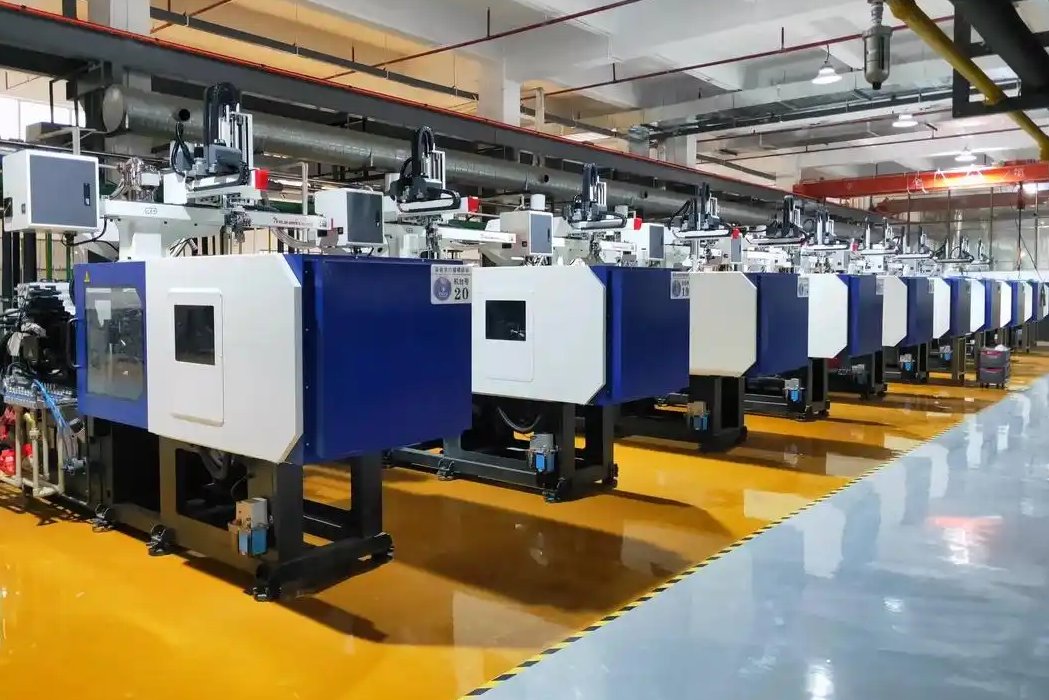
A large contract manufacturer's Vietnam injection-molding plant operates 60+ machines spanning a decade-old legacy controllers from Hongxun, Haitian, Sumitomo and Taisu, whose OEMs do not release external communication protocols. AIXOT deployed a combined solution of the AIS-G160 (protocol gateway) (protocol integration for Hongxun/Haitian) and the AIS-T100 (video-OCR data-collection gateway) (video-OCR acquisition for Sumitomo/Taisu), completing plant-wide networking of all injection-molding machines within 15 days, raising key process-parameter coverage from 0% to 95%+, with zero modification to the original systems and closing the last gap for MES integration.
Core Solution for This Case
1. Customer Background
A large contract-manufacturing group's Vietnam manufacturing base, supplying global automotive-component and small-appliance brands.
- The customer is a large contract-manufacturing group that operates an injection-molding base in Vietnam, doing plastic-parts contract manufacturing for global automotive-component and small-appliance brands, with annual output value in the billions of RMB.
- The Vietnam plant operates more than 60 injection-molding machines across Hongxun, Haitian, Sumitomo and Taisu, four brands with machine ages ranging from 8 to 15 years — a typical old plant characterized by early establishment, mixed equipment and many brands. The group headquarters is driving group-wide MES rollout, and the Vietnam plant is among the first pilots.
2. Core Challenges
Four brands, two situations: Hongxun/Haitian "have protocols but no one to connect them", Sumitomo/Taisu "have screens but no interface".
- The group required the Vietnam plant to serve as the first MES pilot, acquiring key process parameters of 60+ injection-molding machines (injection speed, holding pressure, mold temperature, material temperature, cooling time, screw speed, etc.) into MES in real time for production traceability, mold-life monitoring and OEE dashboards.
- Hongxun and Haitian controllers: the equipment itself has RS485 / Ethernet ports and is technically integrable via protocol, but the OEM provides no communication-protocol documentation and offers no integration support; the plant IT team lacks injection-molding protocol-development experience, so it is "a road that exists but cannot be travelled".
- Sumitomo and Taisu controllers: decade-old Japanese/Taiwanese legacy models whose screens clearly show key parameters. Although the equipment also has physical interfaces such as serial and Ethernet ports, their OEMs release no communication protocol — with no protocol documentation and no way to integrate for acquisition, it is "has interfaces but no protocol". However, on-site investigation found that both controllers' hardware uses industrial motherboards or fanless industrial PCs with standard VGA / DVI video output ports — which left the possibility of "acquiring by reading the screen" for later.
- Coordinating with OEMs one by one would involve four brands and three companies (Hongxun and Haitian belong to one group; Sumitomo and Taisu are independent), with a coordination cycle of at least 3–6 months, and the Vietnam plant is far from the OEM service networks, making travel and technical-support costs extremely high.
- Result: the MES pilot stalled at "device data cannot come up", and the key process-parameter acquisition coverage of the 60+ injection-molding machines remained at 0% for a long time. The group set a three-month deadline, putting enormous pressure on the Vietnam plant's IT team.
3. Why Traditional Approaches All Failed
'Protocol integration finds no contact, controller upgrade is too costly, replacing all equipment is even more impossible' — all three paths rejected.
- Option A: OEM protocol integration. Hongxun/Haitian theoretically have protocols but require individual coordination, while Sumitomo/Taisu have no external interface at all. The four brands and three companies are located across mainland China, Japan and Taiwan, China — cross-region coordination takes over 6 months with an estimated cost of RMB 500K+, far exceeding the pilot deadline.
- Option B: Replace controllers with new models. A single Hongxun/Haitian upgrade costs about 15k–20k RMB (including downtime); Sumitomo/Taisu Japanese-OEM upgrades are even more expensive; 60+ units total over 1 million RMB, and the Vietnam plant must schedule downtime and wait for OEM technical service on-site, affecting delivery schedules.
- Option C: Batch retire-and-replace. The 60+ machines can still serve 5–10 years without issue; batch replacement means tens of millions in investment and a 2–3 year cycle, which is entirely infeasible for an overseas greenfield plant still ramping up capacity.
- The customer at one point considered manual entry in Vietnam plus Excel reporting to MES, accepting the compromised approach of lagging data and lack of real-time visibility — until learning about AIXOT's G160 + T100 "protocol + screen" dual-channel combined solution.
4. Solution: G160 Protocol Integration + T100 Video OCR as Backstop
'Those with protocols go via protocol, those without read the screen' — one solution, two channels, four brands integrated uniformly.
- Channel 1: AIS-G160 (protocol gateway) integrates with Hongxun and Haitian controllers. The G160 has a built-in library of 500+ industrial-device protocols, including complete protocol drivers for Hongxun and Haitian injection-molding machines. Connected directly to the controllers via RS485 / Ethernet port, it performs protocol-level acquisition of core parameters such as injection speed, holding pressure, mold temperature and material temperature, with the highest real-time performance and best accuracy.
- Channel 2: AIS-T100 (video-OCR data-collection gateway) backs up Sumitomo and Taisu legacy controllers. On-site investigation found that both Sumitomo and Taisu controllers use industrial motherboards or fanless industrial PCs with standard VGA / DVI video output ports; the customer was first asked to connect an external monitor to verify — the picture output normally and was identical to the screen on the injection-molding machine operator panel, confirming that the T100 video-OCR solution was applicable. The controller's VGA / DVI signal was then split by a splitter — one path to the original panel, one path into the T100 — and OCR recognition templates were configured separately for Sumitomo's and Taisu's screen interfaces to capture every process parameter on screen page by page.
- The structured parameters collected by G160 and T100, after edge-side timestamp alignment, are reported uniformly via MQTT / Modbus TCP to the DVS Data-Acquisition & Visualization Platform — protocol-layer and screen-layer data are unified and modeled in DVS, and integrate upward with the group MES through a standard API.
- For some non-standard fields of Hongxun/Haitian (such as automatic mold-number recognition), T100 also performs auxiliary OCR supplementary acquisition, cross-validated against G160 protocol data to further improve parameter coverage and accuracy.
- The 60+ injection-molding machines were connected in batches with parallel implementation: about 40 Hongxun/Haitian machines went through the G160 protocol channel, and about 25 Sumitomo/Taisu machines through the T100 video-OCR channel. The entire plant was networked within 15 days, and key process-parameter coverage jumped from 0% to 95%+.
5. Deployment Outcomes
All 60+ four-brand legacy injection-molding machines networked in 15 days; the MES pilot advanced on schedule.
- Key-parameter acquisition coverage jumped from 0% to 95%+; 8–12 process parameters per machine flow into MES in real time, and the group's first MES pilot advanced on schedule.
- Zero original-system modification, zero downtime: four brands of 60+ injection-molding machines were connected in batches within 15 days while production lines ran normally and orders were unaffected.
- Compared with the "OEM protocol-by-protocol integration" path, the cycle was shortened by 90%+ (from 6 months+ to 15 days) and cost reduced by 70%+ (from RMB 500K+ down to RMB 250K-level), while avoiding the complex cross-region OEM coordination.
- Screen-layer and protocol-layer dual-source data are unified and modeled on the DVS platform, and the MES side perceives no underlying difference — whether G160 protocol data or T100 OCR data, the upper layer sees a consistent parameter structure.
- The solution is highly replicable: when adding a new brand of controller, those with protocols go through G160 and those without through T100, configured by template without re-coordinating with the OEM.
6. Why the G160 + T100 Combination
'Those with protocols go via protocol, those without read the screen' — the most realistic device-networking strategy for industrial sites.
- The G160's 500+ protocol library includes native protocol drivers for injection-molding brands such as Hongxun, Haitian and Chen Hsing; what G160 does is "protocol translation" — unifying each vendor's proprietary protocol into a standard data format, with optimal real-time performance.
- What T100 does is "screen translation" — for devices that have a screen but no interface, it uses the video signal for external image capture and OCR recognition, turning "visible" into "acquirable".
- The combination essentially realizes AIXOT's philosophy of total-plant device digitalization: a protocol-layer + screen-layer dual-source data closed loop that covers 100% of device types, leaving no "unconnectable" equipment.
- This case solved a complex scenario spanning four brands across China, Japan and Taiwan in 15 days at the RMB 250K-level; using traditional methods alone would take half a year+ and RMB 500K+ — this is the core value of the G160 + T100 combination in "real equipment sites".
- More importantly, the solution provides the group with a "run once, replicate across the whole group" template for its multiple old plants in China — whether devices go via protocol or via screen, the architecture, data and MES integration are all consistent.
7. Multi-Brand Injection-Molding Machine Access-Method Comparison
An overview of the division of labor: "those with protocols go via protocol, those without read the screen".
| Brand | Controller Characteristics | Access Method | Acquired Parameter Scope | Integrated Product |
|---|---|---|---|---|
| Hongxun | Has RS485/Ethernet port, protocol integrable | Protocol Direct Acquisition | Injection speed, holding pressure, mold temperature, material temperature, cooling time, etc. | AIS-G160 (protocol gateway) |
| Haitian | Has RS485/Ethernet port, protocol integrable | Protocol Direct Acquisition | Injection speed, holding pressure, mold temperature, material temperature, screw speed, etc. | AIS-G160 (protocol gateway) |
| Sumitomo | Legacy Japanese-brand controller, has interface but no protocol | Video OCR | All visible parameters on screen (8–12 items) | AIS-T100 (video-OCR data-collection gateway) |
| Taisu | Legacy Taiwanese-brand controller, has interface but no protocol | Video OCR | All visible parameters on screen (8–12 items) | AIS-T100 (video-OCR data-collection gateway) |
8. Traditional Approach vs. AIXOT G160 + T100 Combined Solution Comparison
| Dimension | Traditional Approach: OEM Protocol Integration + Upgrade, One by One | AIXOT Solution: G160 Protocol + T100 Video OCR Combination |
|---|---|---|
| Deployment Cycle | 6 months+ (cross-region OEM coordination) | 15 days (batched parallel access) |
| Cost (60+ machines) | RMB 500K+ (communication + development + travel + upgrade) | RMB 250K-level |
| Impact on Production | Each upgrade requires 4–8 hours downtime | Zero downtime, plug-and-play |
| Multi-Brand Coverage | Requires coordinating OEMs one by one; Sumitomo/Taisu have no interface to integrate | Protocol + OCR dual-channel covers all brands |
| Parameter Coverage | Partial (OEM opens only some parameters) | 95%+ (full protocol parameters + OCR supplementary acquisition cross-validation) |
| Replicability | Each added brand repeats the whole process | New brands configured by template |
| Group-Wide Reuse | Each country's plants coordinated independently | Same architecture, one verification, replicated across the whole group |
9. Frequently Asked Questions (FAQ)
Common questions about "multi-brand legacy injection-molding machine combined access".
What protocols do Hongxun and Haitian use, and is OEM cooperation required?
Hongxun and Haitian injection-molding controllers have RS485/Ethernet communication capability and use proprietary protocols. The G160 has built-in native protocol drivers for these brands; once physically connected, it auto-identifies and integrates without requiring the OEM to provide protocol documentation or send personnel for support.
Sumitomo and Taisu expose no external communication protocol — how is acquisition accuracy guaranteed?
Sumitomo and Taisu legacy controllers are early Japanese/Taiwanese models. Although they have physical interfaces such as serial and Ethernet ports, their OEMs do not release communication protocols, so protocol-based integration is impossible. On-site investigation found that their hardware uses industrial motherboards or fanless industrial PCs with standard VGA / DVI video output ports, and the externally connected monitor displays exactly the same screen as the operator panel. The T100 captures the video stream and uses deep-learning OCR to recognize the parameters shown on screen, achieving up to 99% overall recognition accuracy. The T100 performs acquisition only, with no control function, and has zero impact on the original system.
How are G160 and T100 data unified into the MES?
Data from both channels is unified with timestamp alignment on the DVS Data-Acquisition & Visualization Platform, and exposed upward through a standard API as a consistent parameter structure. The MES side does not need to care whether data comes from protocol or screen — it calls the same field set and sees no underlying difference.
How was the entire plant networked within 15 days?
The key is template-based configuration rather than custom development: the G160 Hongxun/Haitian protocol drivers are plug-and-play, and T100 OCR templates are shared across the same machine models. On-site work is mainly physical wiring and template verification, with 60+ machines rolled out in batches. About 40 Hongxun/Haitian machines use G160 and about 25 Sumitomo/Taisu machines use T100, configured in parallel with alternating go-lives.
The Vietnam plant is remote with slow OEM response — how do we handle future expansion?
The template-based approach is inherently suited to overseas plants: whether adding injection-molding machines or new brands, those with protocols go through G160 and those without go through T100, simply by configuring templates. There is no need to rely on OEM on-site presence; once the plant IT team learns the basic operations, it can expand and maintain the system on its own.
Related Scenarios & Products
Legacy Closed Island Systems
Video OCR integration of an LCD-panel plant's environmental-monitoring system into an IoT platform
→ View CaseSMT Line Yield Optimization
G160 + T100 + DVS + AI: whole-line SMT data acquisition and yield improvement
→ View CaseAIS-G160 Product Page
500+ protocol industrial gateway · injection-molding machine protocol library
→ View Product